Global Electric Vehicle Trends 2026: A Complete Guide
Discover global electric vehicle trends in 2026, including EV benefits, charging technology, battery range, ownership costs, and what international car buyers should consider

Discover global electric vehicle trends in 2026, including EV benefits, charging technology, battery range, ownership costs, and what international car buyers should consider
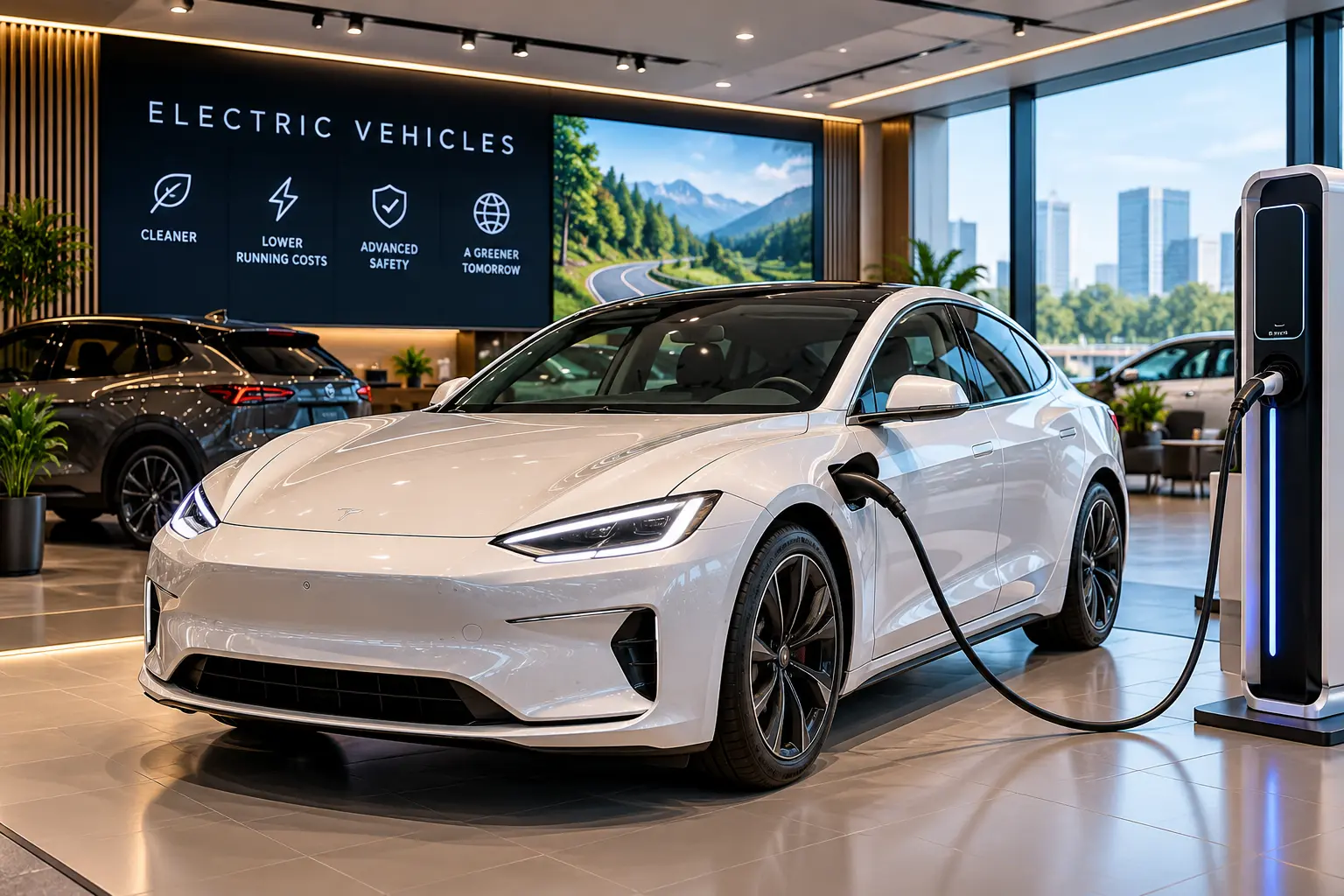
Global electric vehicle trends 2026 are transforming the automotive industry through advances in battery technology, expanding charging infrastructure, improved vehicle efficiency, and a wider choice of electric cars. From affordable city vehicles to premium electric SUVs, manufacturers are developing new models to meet the changing needs of drivers around the world.
Electric vehicles (EVs) are becoming an important alternative to petrol and diesel cars. Many buyers are interested in their potential running-cost savings, quiet performance, modern technology, and reduced tailpipe emissions. However, choosing an electric car requires more than comparing advertised range or purchase prices. Charging access, battery warranties, local electricity costs, and after-sales support also matter.
According to the International Energy Agency (IEA), global electric car sales exceeded 20 million in 2025, representing approximately one-quarter of all new cars sold worldwide. The IEA's 2026 outlook projects that annual sales could reach around 23 million in 2026, although actual results will depend on market conditions, prices, and government policies.
This guide explores the major electric vehicle developments in 2026 and explains what international buyers should know before choosing their next car.
The electric vehicle market continues to expand, but its growth differs across regions. China remains the largest market for electric cars, while Europe has recorded strong growth. Adoption is also increasing in several emerging markets as more models become available.
In 2025, China accounted for more than half of global electric car sales. Europe also experienced a significant increase, while sales patterns in the United States were influenced by changing incentives and market conditions.
These differences demonstrate why international buyers should research their local market before purchasing an electric vehicle. Import duties, registration charges, charging infrastructure, warranty coverage, and spare-parts availability can all affect the overall cost of ownership.
For the latest market analysis, read the International Energy Agency's Global EV Outlook 2026.
Several factors are encouraging consumers to consider electric cars for commuting, family transport, and business use.
Electric vehicles can cost less to operate than comparable petrol or diesel vehicles because electric motors use energy efficiently. Drivers who can charge at home may benefit from convenient charging and potentially lower energy costs.
However, savings are not guaranteed in every situation. Electricity tariffs, fuel prices, annual mileage, vehicle efficiency, and public charging fees all influence the final cost.
Before purchasing, compare the estimated cost per kilometre or mile for an EV with that of a similar conventional vehicle.
Battery-electric cars produce no tailpipe exhaust while driving. This can help reduce local road-traffic emissions, particularly in busy urban areas.
Their complete environmental impact also depends on electricity generation, battery production, vehicle manufacturing, and recycling. For this reason, it is more accurate to discuss reduced tailpipe emissions than to describe every electric vehicle as entirely emission-free.
Electric motors generally deliver smooth acceleration and produce less noise than conventional combustion engines. This can improve comfort during city driving and stop-and-go traffic.
Many electric cars also use regenerative braking, which recovers some energy during deceleration and returns it to the battery.
Many newer EVs offer digital dashboards, connected navigation, smartphone integration, remote vehicle controls, and driver-assistance features.
The availability of these technologies depends on the manufacturer, model, trim level, and country. Buyers should confirm the exact equipment and software support offered with the vehicle they intend to purchase.
Battery performance remains one of the most important considerations when comparing electric vehicles. The battery determines how much energy the car can store and influences its driving range, charging requirements, weight, and price.
Manufacturers typically advertise range figures measured under specified testing procedures. Real-world range can differ because of driving speed, weather, road conditions, passenger load, battery age, and heating or air-conditioning use.
Several factors can influence how far an electric car travels on a single charge:
Driving speed: Sustained high-speed driving generally consumes more energy.
Weather: Very cold or hot conditions can affect battery performance and climate-control consumption.
Driving style: Rapid acceleration and hard braking can reduce efficiency.
Vehicle load: Additional passengers and luggage can increase energy use.
Tyre condition: Incorrect tyre pressure can reduce efficiency.
Battery condition: Battery health can influence the available energy in an older vehicle.
Drivers who mainly commute short distances may not need the largest available battery. A vehicle with a suitable daily range and convenient charging can be more economical than paying extra for capacity they rarely use.
People who regularly travel long distances may prefer greater range, faster charging capability, and reliable charging stations along their routes.
For a used EV, consider requesting a battery health report and checking the remaining battery warranty, service history, accident records, and availability of specialist repairs.
Charging access can determine whether an electric vehicle fits a buyer's lifestyle. The main charging options include home charging, public charging stations, and DC fast charging.
Home charging is convenient for drivers who have private parking and a suitable electrical installation. Charging overnight can provide enough energy for many daily journeys.
Before installing a home charger, check local electrical regulations, installation costs, charger compatibility, and the maximum AC charging rate supported by your vehicle.
People living in apartments should confirm whether their building provides shared chargers or permits individual installations.
Public charging networks are useful for drivers without home charging access and for people travelling longer distances.
Before purchasing an EV, check stations near your home, workplace, shopping areas, and regular travel routes. Review connector compatibility, payment methods, operating hours, charging speeds, and network reliability.
A station's presence on a map does not guarantee that a compatible charger will be available when you need it.
DC fast chargers can add energy more quickly than ordinary AC chargers. However, charging speed depends on the vehicle's charging capability, battery temperature, charger output, and current battery charge level.
Charging generally slows as the battery approaches a high state of charge. Therefore, a manufacturer's maximum charging rate should not be treated as the speed maintained throughout an entire charging session.
The US Department of Energy's Alternative Fuels Data Center provides useful information about electric vehicles, charging systems, and electricity as a transportation fuel.
Choosing between an electric car and a conventional vehicle requires a comparison of the total ownership cost rather than the purchase price alone.
Some electric cars have higher upfront prices than comparable petrol vehicles, while other models are competitively priced. Government incentives, import duties, taxes, financing, and dealer offers can change the final amount significantly.
Compare vehicles of similar size, equipment, safety features, and performance to make a fair assessment.
Battery-electric vehicles do not require conventional engine oil changes and have fewer moving powertrain components than many combustion-engine vehicles.
They still require routine inspections, tyre maintenance, brake checks, suspension servicing, cabin-filter replacement, and other scheduled work. Repairs involving batteries or high-voltage components can be expensive without suitable warranty coverage.
Before buying, check whether qualified technicians, diagnostic equipment, and replacement parts are available in your region.
Electricity can be cheaper than petrol or diesel for equivalent travel, but the difference depends on local prices and charging methods.
Home charging may be economical in some regions, while frequent use of expensive public fast chargers can reduce potential savings. Buyers should estimate annual energy costs using their expected mileage and local tariffs.
An EV's resale value depends on brand reputation, battery health, warranty coverage, vehicle condition, local demand, and the availability of newer models.
For used electric cars, documented battery condition and a reliable maintenance history can help buyers assess the vehicle more confidently.
Selecting the right vehicle starts with understanding how you will use it.
Consider your average daily distance, regular passengers, luggage requirements, and the frequency of long-distance journeys. A compact EV may suit city commuting, while a larger model may better meet family requirements.
Include the purchase price, financing, insurance, registration, charging equipment, electricity, maintenance, and tyres. If you are importing a vehicle, include shipping, customs duties, and any required compliance costs.
Determine whether you can charge at home, at work, or at reliable public stations. Consider the distance to alternative charging points in case your preferred station is unavailable.
Read independent vehicle tests and consider the weather and road conditions in your country. Avoid basing your decision entirely on the highest advertised range figure.
Check the warranty period, mileage limits, exclusions, battery-capacity conditions, and whether coverage transfers to a subsequent owner.
Confirm the availability of authorised service centres, replacement parts, software support, and technicians trained to work on high-voltage systems.
Vehicle import rules, taxes, registration requirements, incentives, and charging standards vary by country. Confirm the applicable requirements before paying a deposit or arranging an import.
For more automotive information, visit the KOZAN Motors website.
Electric vehicles are not the only option for people looking to reduce fuel consumption. Hybrid technology offers an alternative for drivers whose charging access or travel patterns make a fully electric vehicle less practical.
Battery-electric vehicles use an electric motor for propulsion and store energy in a rechargeable battery. They need access to a compatible charging source and produce no tailpipe emissions during driving.
Conventional hybrids combine a combustion engine with an electric motor and a relatively small battery. They generally do not need to be plugged in because the battery is charged through the engine and regenerative braking.
Plug-in hybrids have a larger battery that can be charged externally. They can complete some journeys using electric power, then use the combustion engine when needed, depending on the model and driving conditions.
The best choice depends on charging availability, daily mileage, budget, and the type of journeys you regularly make.
Electric vehicle technology continues to develop across batteries, charging systems, software, and vehicle design.
Research is focused on energy density, durability, charging performance, safety, and manufacturing costs. Improvements in these areas could make EVs more practical for a wider range of buyers.
The pace of development differs across manufacturers and battery chemistries. Buyers should compare currently available specifications rather than relying on unconfirmed promises about future products.
New charging systems and battery designs are helping some vehicles accept higher charging power. Smart charging can also shift charging to periods when electricity demand or prices are lower, where compatible systems and tariffs are available.
Vehicle-to-grid technology can allow compatible EVs to send electricity back to the grid, but commercial availability, regulations, and vehicle support remain different across markets.
Automakers are increasingly using software to manage vehicle functions, navigation, energy consumption, and connected services. Some models receive software updates remotely.
Driver-assistance systems can help with certain driving tasks, but their capabilities vary and they do not remove the driver's responsibility to pay attention. Buyers should check system limitations, local regulations, data privacy, and ongoing software support.
Manufacturers are introducing EVs across different price ranges and vehicle categories, including compact cars, family SUVs, luxury vehicles, and commercial vehicles.
More choice can help consumers find a suitable vehicle, although availability, prices, servicing, and spare parts remain dependent on the local market.
They can be cheaper to run when electricity costs less than the fuel required for equivalent travel. Actual savings depend on electricity prices, fuel prices, charging methods, vehicle efficiency, mileage, and maintenance.
Range varies by model and battery capacity. Speed, weather, driving style, road conditions, battery condition, and climate-control use can all affect real-world range.
Charging time depends on battery capacity, the charger's output, the vehicle's charging limits, and the battery's current charge level. Home AC charging is generally slower than compatible DC fast charging.
Yes, where reliable charging infrastructure is available. Drivers should plan charging stops, check connector compatibility, and allow enough time for charging and unexpected delays.
A used EV may offer good value if its price, battery condition, warranty, and maintenance history are suitable. An independent inspection and a review of local repair support are recommended.
Battery-electric vehicles produce no tailpipe exhaust while driving. Their full environmental impact also depends on electricity generation, battery manufacturing, vehicle production, and end-of-life treatment.
An EV may suit drivers with convenient charging and predictable daily journeys. A conventional hybrid may be more practical where charging is difficult or long journeys frequently pass through areas with limited charging facilities.
Global electric vehicle trends 2026 show how the automotive industry is adapting to new technologies, changing consumer needs, and expanding electric mobility. Battery development, charging infrastructure, model availability, and ownership costs will continue to influence the decisions of international buyers.
Electric cars can provide efficient driving, quiet performance, and reduced tailpipe emissions. However, the right choice depends on personal driving habits, local electricity prices, charging access, warranty coverage, and the availability of reliable servicing.
Before purchasing an electric vehicle, compare the total cost of ownership, investigate local regulations, and verify the vehicle's specifications with the manufacturer or an authorised dealer. A careful comparison can help you choose a vehicle that fits your budget and everyday requirements.
KOZAN Motors encourages readers to research their options, compare available models, and make informed automotive decisions based on their individual needs.